PERSONNEL FILE 002 · THE EVIDENCE LAB

Johnny Five.

Evidence & Knowledge Controller

Checks sources, remembers what we learned, and asks the one question a confident dashboard would rather avoid: Can we prove it?

FICTIONAL CREW MEMBER · REAL EVIDENCE PRINCIPLES · NO AUTOMATED DECISIONS

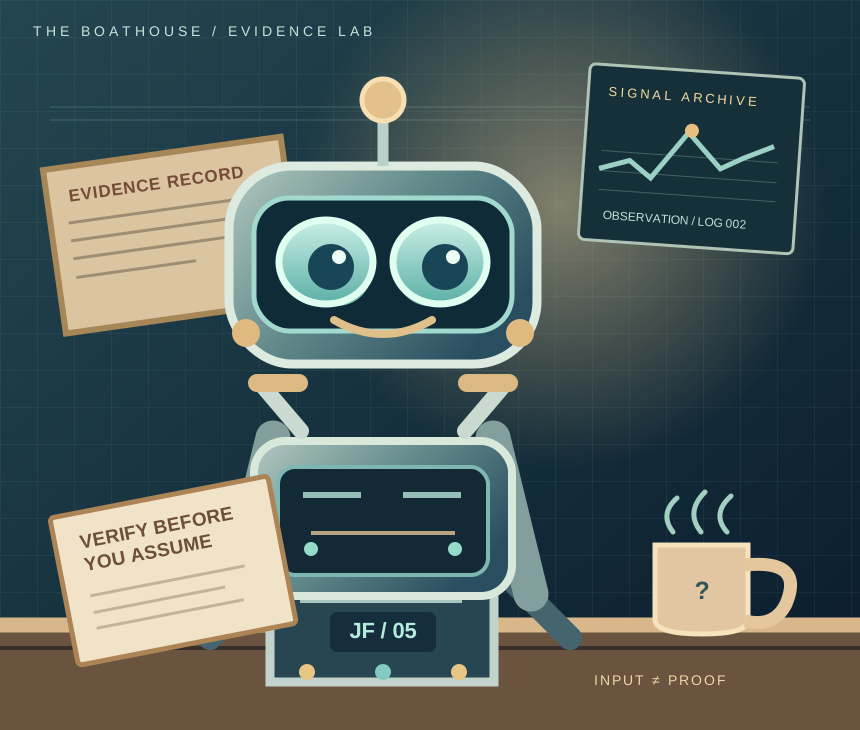
EVIDENCE STATION · 002Original illustration of Johnny Five, a friendly retro robot with teal binocular eyes in a lamplit evidence laboratory, surrounded by filing cards and an observation console
“An interesting result. Now show me the source.”
01 OBSERVE02 VERIFY03 PRESERVE04 REVISIT

JOHNNY FIVE'S DESK · TRAINING MODE

The Evidence Console.

Three plausible claims. Three different evidence problems. Open a file to see how Johnny would investigate before declaring victory.

CASE 01“The dashboard says zero. Nothing happened.”Inspect file
UNKNOWN · MORE EVIDENCE REQUIRED

Observed: A sample dashboard tile displays zero.

Not established: Whether collection worked, the date range is complete, or events occurred outside that report.

Next check: Test instrumentation and compare an independent signal.

CASE 02“These two reports disagree. One must be wrong.”Inspect file
INFERRED · SCOPE NOT RECONCILED

Observed: Two fictional reports show different totals.

Not established: That they measured the same population, time period, filters, or definitions.

Next check: Align measurement scope before naming an error.

CASE 03“We captured the source. The answer is settled.”Inspect file
OBSERVED · LIMITED TO THE RECORD

Observed: A fictional log includes a source address, timestamp, and captured response.

Not established: That the source remains unchanged or that one observation proves every interpretation.

Next check: Preserve the source context and schedule a fresh check when currency matters.

Illustrative examples only. This console does not inspect live websites, access client data, or independently validate claims.

MISSION BRIEF

What Johnny Five brings aboard.

Johnny Five is our fictional record keeper: less impressed by a confident claim than by a dated source, a reproducible check, and a clear note about what is still unknown.

“INPUT IS NOT THE SAME AS PROOF.”

THREE THINGS ON THE RADAR

Source and provenance

Where a claim came from, when we checked it, and what that source can actually support.

Conflicting records

Two versions of the truth that need reconciliation, not quiet deletion.

The unknowns

Blank spaces that must stay blank until evidence earns an answer.

How the work gets done

Collect the evidence, note its limits, compare against prior observations, and label what is verified, inferred, or unresolved.

The boundary: No invented citations, no treating stale data as fresh, and definitely no turning unknown into zero.

OPEN THE DESK DRAWER

Curiosity is part of the job.

Every good field note includes a little personality. Open the memo—or check the handoff—to see how this station thinks.

Browse the full manifest ↗
Read today's fictional field memo

Inventory complete: 14 observations, 9 supporting sources, 3 unresolved questions, and one suspiciously confident spreadsheet.

What's this station actually responsible for?

Collect the evidence, note its limits, compare against prior observations, and label what is verified, inferred, or unresolved.

Who takes the next watch?

Radar can keep watch on the things that may change tomorrow. Open Radar's personnel file ↗

KEEP EXPLORING

Meet another perspective.

The crew is a fictional storytelling device for how the work is explored, checked and discussed. They are not employees, licensed experts or independently operating consultants. William remains responsible for the real work.

← Back to the Human · All personnel files ↗